

Whole-system pressure checks
The system is pressure-tested to confirm a leak exists and to narrow which part of the system is losing water.
Detection is a diagnosis service, not a repair service. Its product is a location, proven by more than one method, that a repair can then target.
The system is pressure-tested to confirm a leak exists and to narrow which part of the system is losing water.
Sensitive listening equipment picks up water escaping from a hidden line, narrowing the search to an area before anything is opened.
The meter is watched and fixtures are isolated in turn, separating a supply leak from a fixture problem or a running toilet.
Warm spots and damp areas are checked to corroborate what listening and pressure testing suggest, so one method never decides alone.
The located leak is marked, so the repair that follows opens the right place — not a search pattern across a wall or floor.
Leak detection in Anaheim is shaped by two facts about the city. The first is the housing: much of the flatland stock is 1950s–1960s slab tracts, so a supply leak often hides under concrete, showing only as a warm floor spot, damp carpet or a bill spike. The second is the pipe: galvanised supply lines in those tracts corrode from the inside, and copper develops pinhole leaks after decades in very hard water, so leaks are a matter of ageing material as much as of accidents.
Detection covers hidden supply leaks everywhere except under the slab, which has its own page — slab-leak repair — because slab work has its own symptoms, diagnosis and repair-versus-reroute decision. Everywhere else, the method is the same: pressure, listening, isolation and corroboration, in that order, until the location is proven. Cost depends on the home's size, the leak's nature and the access; call (657) 680-4140 for a phone quote.
Five steps, in order, from symptoms to a marked location.
Call and describe it
Tell us the symptoms: the bill, the damp spot, the sound, the warm floor. Each one points the search in a different direction.
Confirm a leak exists
The meter and the system pressure are checked first, confirming water is being lost and narrowing which part of the system loses it.
Isolate by section
Fixtures and branches are isolated in turn, separating a fixture problem from a hidden supply leak.
Listen and locate
Acoustic listening narrows the leak to an area, corroborated by thermal and moisture checks where they apply.
Acoustic listening equipment
Sensitive microphones and sensors that pick up water escaping from a hidden line, even through walls and floors.
Pressure gauges
Test the system and its sections, confirming a leak exists and narrowing which branch loses pressure.
Meter-reading checks
Watch the meter with fixtures off, proving water is moving somewhere it should not be.
Thermal imaging
Reads surface temperature differences, corroborating a warm spot from a hot-line leak under a floor or behind a wall.
Moisture meters
Measure dampness in floors, walls and carpets, mapping how far a leak's moisture has travelled.
Isolation valves and caps
Isolate branches and fixtures in turn, so the search narrows by elimination as well as by listening.
Confirm before searching
A leak is proven — meter and pressure — before the search begins, so time is not spent hunting a leak that is actually a fixture.
Isolate, then listen
Isolation narrows the system first; listening narrows the area second. The order keeps the search efficient and the location reliable.
Corroborate, never single-source
No location rests on one method alone. Pressure, listening and moisture or thermal checks must agree before a wall or floor is opened.
Mark before repairing
The location is marked and explained before any repair is discussed, so the repair targets a proven spot.
Phone quote for cost
Home size, leak nature and access drive cost. Call (657) 680-4140 for a phone quote once the symptoms are understood.
01
We check the meter with fixtures off, pressure-test the system, and isolate branches until the losing section is found, then listen for the exact spot.
A located leak and a repair plan aimed at one place, with the bill spike explained by the leak, not by usage.
02
We confirm the sound is a leak, not a fixture, by isolating fixtures in turn, then listen along the supply runs to narrow the source.
A located supply leak behind a wall, marked for a targeted repair instead of a search across the room.
03
We map the moisture, check whether the source is supply, drain or an appliance, and listen for the line behind the damp area.
A proven source — supply leak, drain fault or appliance — with the repair aimed at the right system.
04
We pressure-test and listen along the wall's supply runs, separating a slow supply weep from condensation or a drain issue.
A located weep, marked and explained, with the repair options laid out before anything is opened.
Detection changes with the home: slab tracts hide leaks under concrete, Colony homes hide them in walls and crawlspaces, and Triangle units hide them behind shared walls — each needing a different search.
1950s–1960s slab tracts where leaks hide under concrete and show as warm spots, damp carpet or bill spikes — the classic detection case.
The city's oldest homes, where leaks hide in walls and mixed old-and-new pipe, and where isolation by section matters most.
Older homes and mixed buildings where supply runs are non-standard, and where a leak's symptoms can appear far from its source.
Larger hillside homes with longer supply runs, where a leak can travel before it shows and the search must cover more ground.
Newer condos and townhomes where shared walls mean a leak in one unit can show in another, and isolation must cross unit boundaries carefully.
Very hard water
Anaheim's water is very hard, and decades of scale and corrosion in galvanised and copper lines are the background cause of most hidden leaks.
Slab-on-grade tract construction
Most flatland tract homes sit on slabs, so supply leaks show indirectly — warm spots, damp carpet, bill spikes — rather than as visible puddles.
Ageing galvanised and copper supply lines
Galvanised lines corrode from the inside; copper develops pinhole leaks after decades in hard water. Both fail quietly, behind walls and floors.
Small lots and shared walls
Colony lots and Triangle shared walls mean a leak's symptoms can appear in a different room — or a different unit — from its source.
Hidden leaks announce themselves indirectly. Learning the symptom language is what turns a mystery bill or a damp patch into a located leak.
Problem
A water bill that rises sharply with no change in use is the most common first sign of a hidden supply leak, and the meter is the first witness.
Our Fix
We check the meter with fixtures off, pressure-test the system, and isolate branches until the losing section — then the exact spot — is found.
Problem
Water moving with no fixture open means a supply leak somewhere in the system. The question is where, and listening answers it.
Our Fix
We confirm the sound is a leak by isolating fixtures, then listen along the supply runs to narrow the source to one area.
Problem
Dampness and warmth are a leak's footprints. A warm spot points to a hot line; dampness maps how far the water has travelled.
Our Fix
We map moisture and temperature, listen for the line behind the symptom, and mark the location for a targeted repair.
Problem
A stain that returns after cleaning, or a musty patch near a baseboard, often marks a slow weep that never shows as a puddle.
Our Fix
We pressure-test and listen along the nearby supply runs, separating a supply weep from a drain issue or condensation, then mark the spot.
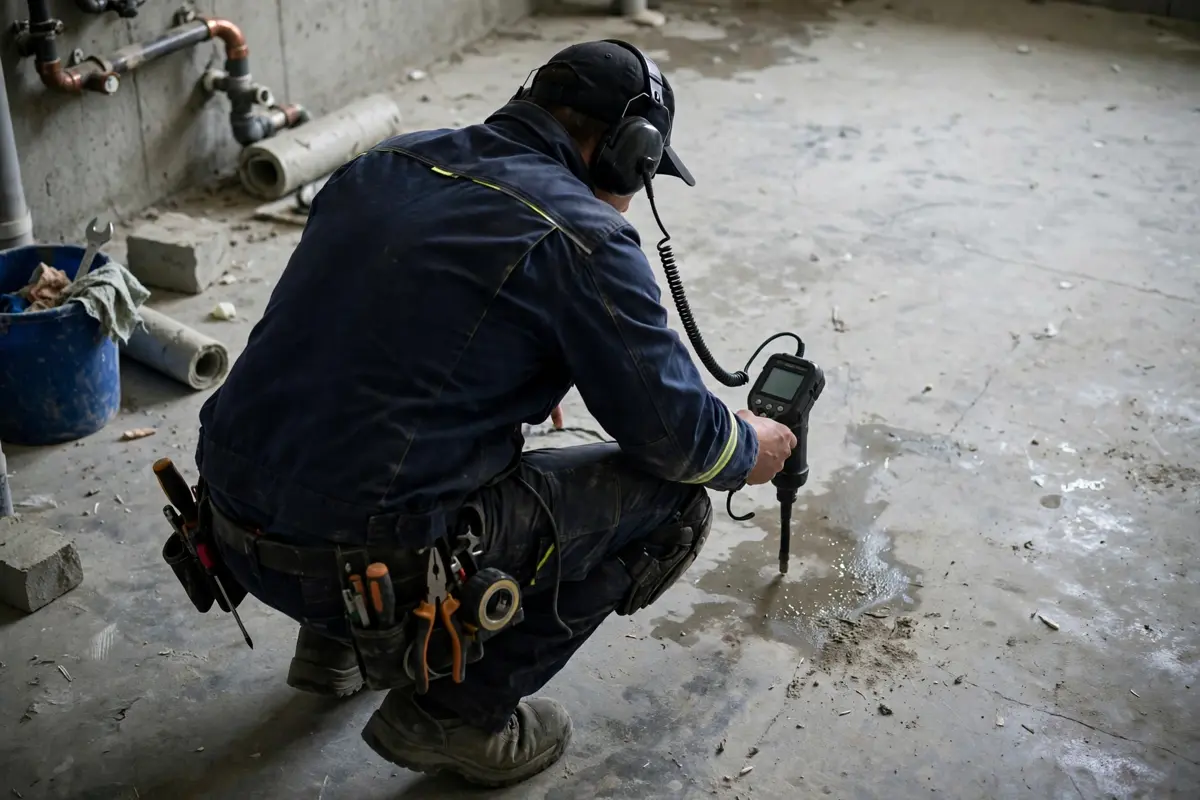
A hidden leak rewards patience and punishes guessing. The search should prove the leak, narrow it, corroborate it, and only then open anything.
Proof before searching
Meter and pressure checks confirm a leak exists before the search begins, so no wall is opened for a leak that is actually a fixture.
Location, not a search pattern
Listening and isolation narrow the leak to a marked spot, so the repair opens one place instead of hunting across a room.
Corroboration on every location
No location rests on one method. Pressure, listening and moisture or thermal checks must agree before anything is opened.
Anaheim housing knowledge
Slab tracts, Colony walls and Triangle shared walls each hide leaks differently, and the search starts from the home's construction, not a generic routine.
Google review — 5 stars
Effortlessly installed our water tank!
Google review — 5 stars
I expected a straightforward process, and that's what happened once coordination with building management was sorted; the plumber installed the new water heater efficiently in about two hours. He made sure to check all connections before leaving, which was reassuring.
Google review — 5 stars
The quote was upfront, and the plumber spent a good hour carefully tracing the leak to an unexpected joint behind a shelf, which was more thorough than my previous experience with another company that missed it entirely. I appreciate that he used a temporary seal until he could return with the proper parts later in the week.
Google review — 5 stars
Unexpected leaks were ruining my morning routine. This plumber arrived on time and swiftly fixed the shower, leaving everything tidy. Their expertise and friendly demeanor made the whole experience stress-free. Highly recommend!
Detection in Anaheim means slab tracts where leaks hide under concrete, Colony homes where they hide in walls and mixed old-and-new pipe, and Triangle units where they hide behind shared walls. The method does not change — prove, isolate, listen, corroborate, mark — but the search adapts to the construction, and the location is never guessed at.
Real Google reviews from customers of Master Anaheim Plumbing CA.
Effortlessly installed our water tank!
นางสาวสุรีรัตน์ เครือบคนโท
Google review — 5 stars
I expected a straightforward process, and that's what happened once coordination with building management was sorted; the plumber installed the new water heater efficiently in about two hours. He made sure to check all connections before leaving, which was reassuring.
CLAIRE TURNER
Google review — 5 stars
The quote was upfront, and the plumber spent a good hour carefully tracing the leak to an unexpected joint behind a shelf, which was more thorough than my previous experience with another company that missed it entirely. I appreciate that he used a temporary seal until he could return with the proper parts later in the week.
พิชามญชุ์ กองทอง
Google review — 5 stars
Straight answers to the questions Anaheim homeowners ask most often about leak detection.
When the leak is under the slab, the symptoms, diagnosis and repair-versus-reroute decision all belong on the slab page.
View Slab Leak RepairA damp patch or a backup with no supply-leak evidence can mean a sewer problem. The camera separates the two systems.
View Sewer Camera InspectionWhen leaks keep appearing in the same ageing runs, the pipe system — not one leak — is the conversation.
View Repiping ServicesA leak between the meter and the home, or a meter that spins with fixtures off, points to the main line.
View Main Water Line RepairA leak that is actively flooding is an emergency first: stop the water, then detect.
View Emergency Plumbing ServicesA puddle near a heater can be a valve, a fitting, or the tank — and detection tells a heater leak from a supply leak.
View Water Heater RepairCall (657) 680-4140. We are open 24 hours, Monday–Sunday, and the phone is our only contact channel — there is no email or contact form. Tell us the symptoms: the bill, the damp spot, the sound.
Phone
(657) 680-4140Address
1282 S Magnolia Ave, Anaheim, CA 92804
Hours
Open 24 hours, Monday–Sunday